Protocol-Qualified Scientific Evidence for Trustworthy Cross-Paper Comparison

🎬 Video coming soon. The recording of this talk will be posted here. Overview Speaker: Harish Varma Siravuri Date: Friday, October 30, 2026, 2:30 PM Room: PM103 Scientific papers are being published far faster than anyone can curate them by hand. So researchers increasingly depend on automatically extracted results (leaderboards, knowledge graphs, and LLM-based extraction) to compare methods across papers. These records are hard to trust, for three reasons. An extractor may copy a value incorrectly. Two values that were extracted correctly may come from different experimental conditions, such as a test split versus a validation split. And a system may name a “winner” that the available evidence does not actually support. ...
October 30, 2026 · 2 min · Harish Varma Siravuri

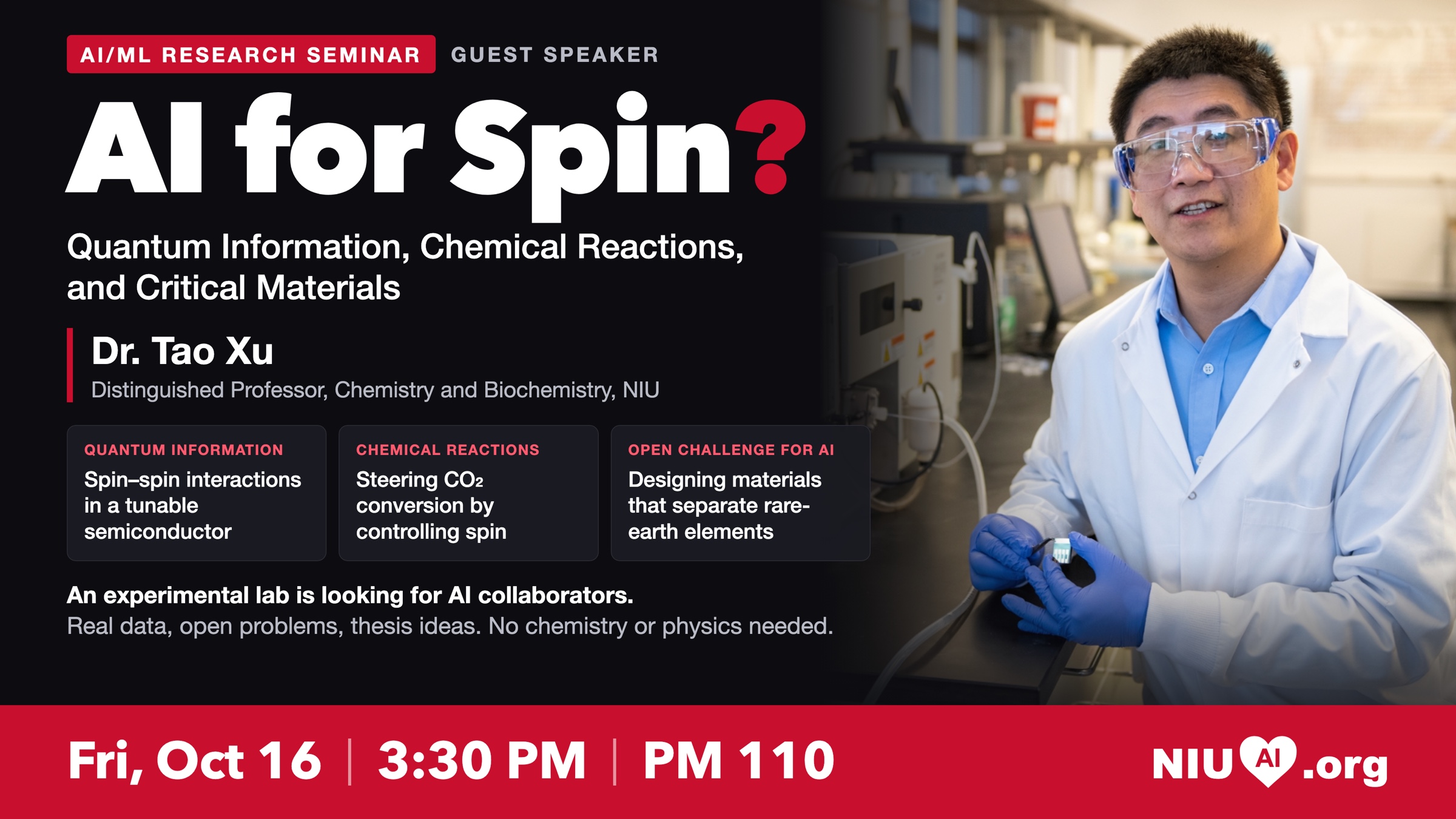
AI for Spin? Quantum Information, Chemical Reactions, and Critical Materials

Overview Speaker: Dr. Tao Xu, Distinguished Professor, Department of Chemistry and Biochemistry, NIU Date: Friday, October 16, 2026, 3:30 PM Room: PM110 An electron carries mass, charge, and spin. Controlling charge gave us modern computing. Controlling spin may give us quantum information, smarter chemistry, and better ways to recover critical materials. Prof. Xu takes us across three frontiers: Quantum information: how a chemically tunable semiconductor enables spin–spin interactions, the basis of a newly funded DOE project on quantum coherence. Chemical reactions: how controlling spin can steer reactions, improving the conversion of CO₂ into useful chemicals using electricity. An open challenge for AI: rare-earth ions with nearly identical charge and size respond differently to magnetic environments. Could AI help design materials that separate elements conventional chemistry struggles to tell apart? Why This Talk This isn’t a talk about using an off-the-shelf model. It’s a direct invitation from an experimental lab looking for AI collaborators. The questions on the table are ones ML researchers care about: Can algorithms uncover hidden interactions from noisy experimental signals? Can they guide which experiment to run next? Can they do inverse design, finding a material for a desired function? If you’re looking for real scientific data, a new application area, or a thesis/project idea, this is a great chance to meet a potential collaborator. No chemistry or physics background is needed. ...

October 16, 2026 · 2 min · Tao Xu

The AI Scientist and Automated Peer Review

Overview Speaker: Md. Toyaha Rahman Ratul Date: Friday, October 2, 2026, 2:30 PM Room: PM103 The story in short: in 2024, Sakana AI introduced “The AI Scientist,” a system that tries to do the full research cycle by itself. It generates an idea, writes the code, runs the experiments, writes the paper, and even reviews it. In 2025, one paper fully generated by its second version passed peer review at an ICLR workshop, with scores of 6, 7, and 6, which was higher than about 55% of the human-written papers there. The team withdrew the paper before publication, as they had planned with the organizers. In 2026, the work was published in Nature. It has started a big discussion in the community about what AI can and cannot do in research. ...

October 2, 2026 · 2 min · Md. Toyaha Rahman Ratul

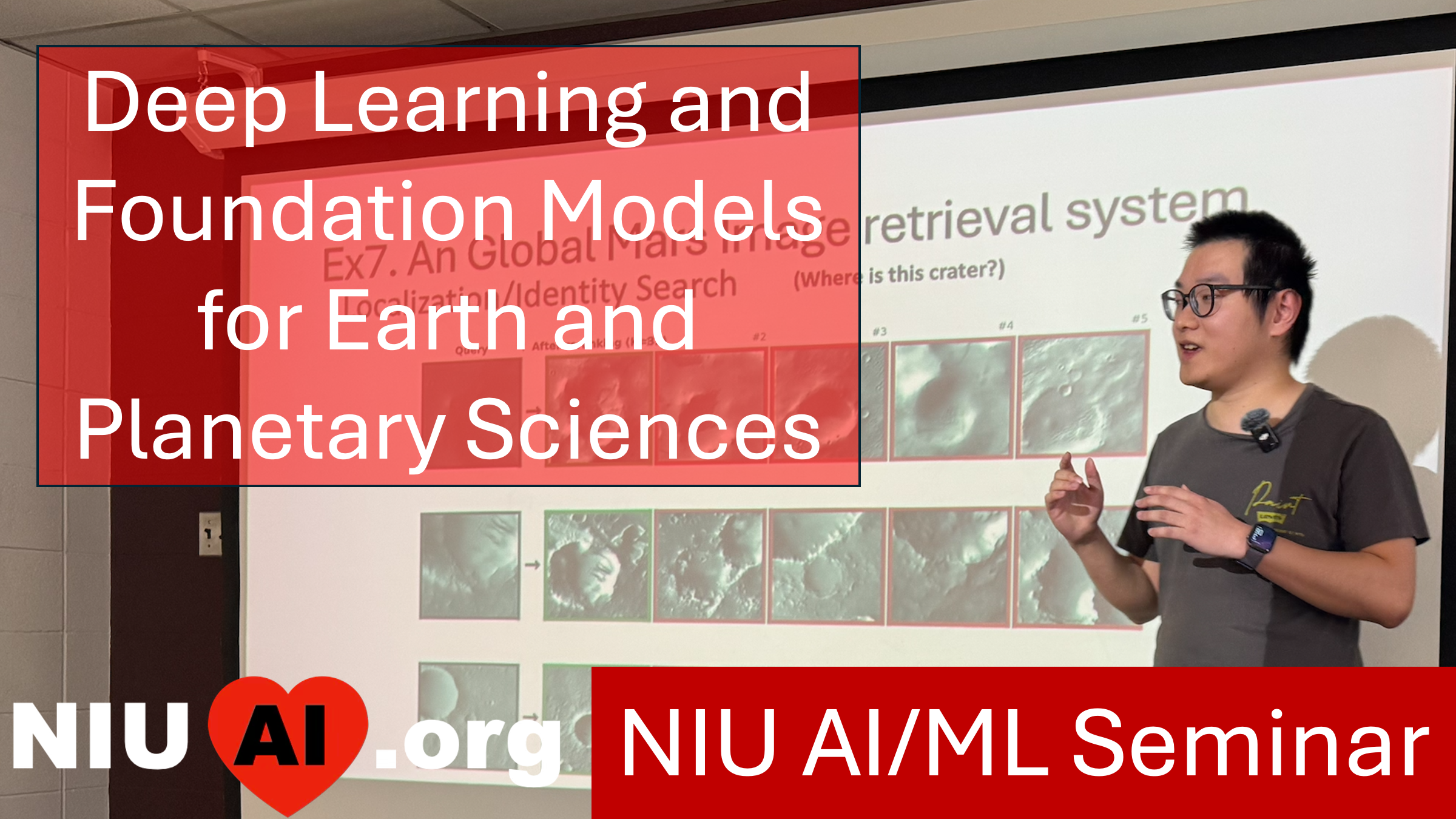
Deep Learning and Foundation Models for Earth and Planetary Sciencess

Download the presentation slides Overview On April 10, 2026, Jichao Fang, a Ph.D. candidate in the Department of Earth, Atmosphere and Environment at Northern Illinois University, presented his research on deep learning and foundation models for Earth and planetary sciences. Jichao is also a Master’s student in Computer Science and is expected to graduate this year. ...

April 10, 2026 · 2 min · Jichao Fang

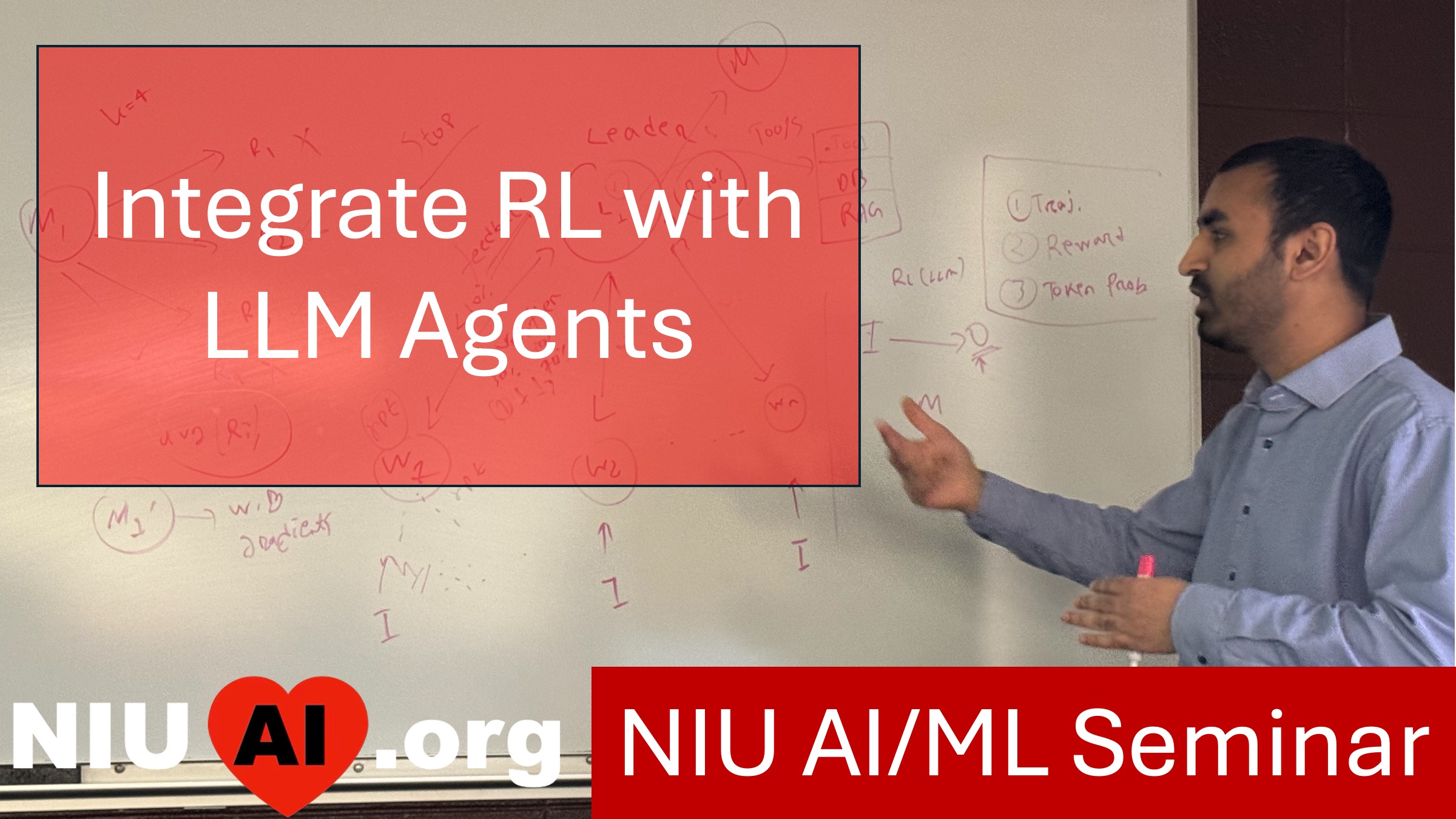
Integrate RL with LLM Agents

Download the presentation slides Overview and Motivation Presentation on integrating reinforcement learning concepts with LLM engines to improve performance Multiple approaches exist to enhance LLM performance: in-context learning, post-training (reinforcement learning), and fine-tuning Focus on efficiently integrating RL concepts with LLMs, particularly for multi-agent systems Covers differences between reinforcement learning on LLMs versus reinforcement learning on LLM agents Addresses RL implementation in HPC systems due to memory-intensive requirements Multi-Agent System Fundamentals Multi-agent systems consist of multiple LLMs, each with specific roles and functions State acts as history, compiling all previous agent turns, context, and evidence in multi-turn systems Communication Topologies ...

February 20, 2026 · 11 min · Ibrahim Al Azher

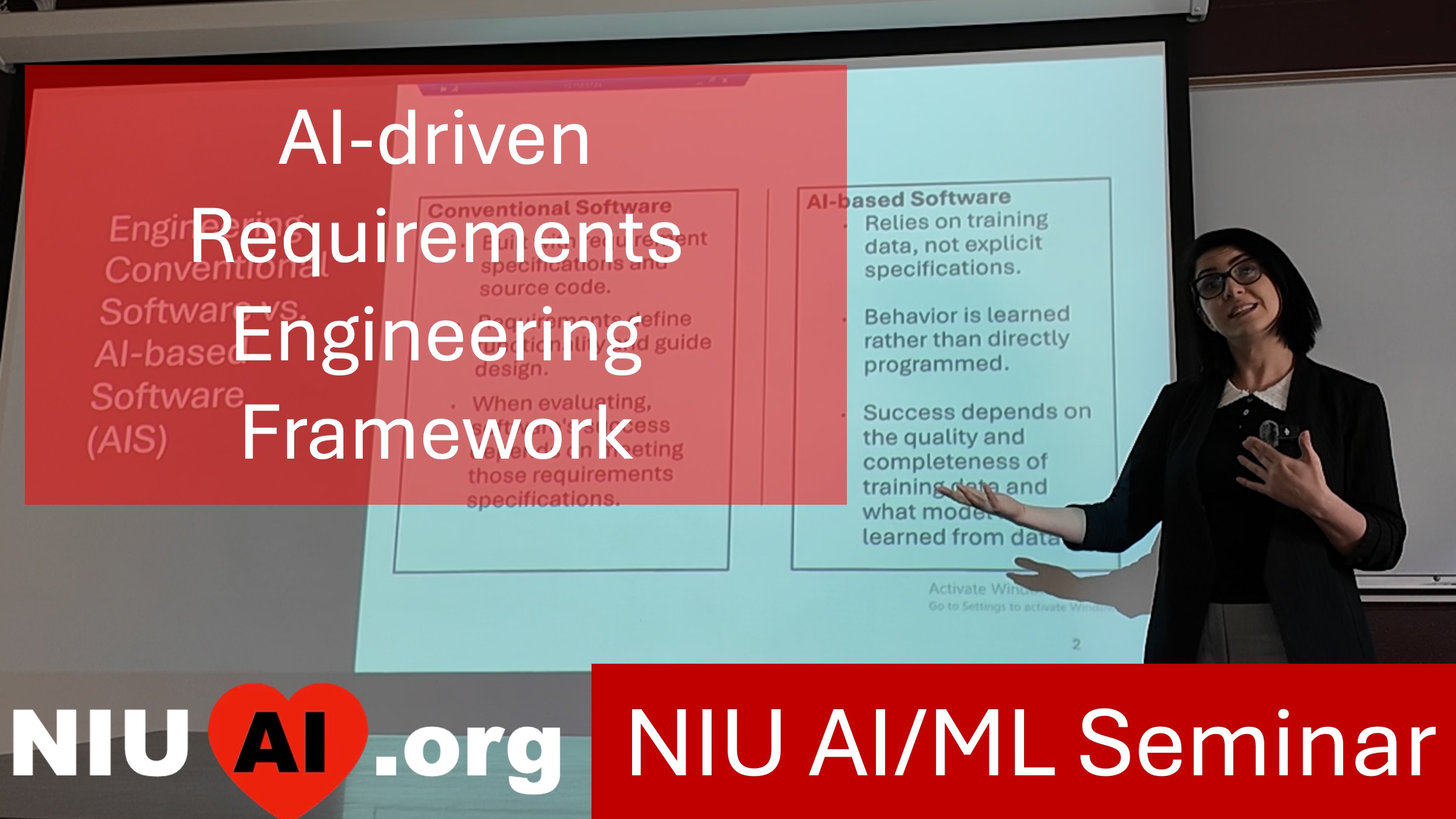
AI-driven Requirements Engineering Framework

Overview On March 21, 2025, Dr. Mona Rahimi, an associate professor in the Computer Science department, delivered a presentation on An AI-Driven Requirements Engineering Framework Tailored for Evaluating AI-Based Software, a problem she and her students have been investigating. With the rise of AI-based software, many traditional software engineering methodologies have become ineffective. In her talk, Dr. Rahimi discussed the redefinition of requirement specification and proposed methods for aligning AI perception with requirements engineering.

March 21, 2025 · 1 min · Mona Rahimi