Stay Connected: Subscribe to receive notifications about upcoming seminars and new presentations.
Share a Talk or Presentation: Interested in giving a talk or presentation? Contact us at contact@niuai.org
Stay Connected: Subscribe to receive notifications about upcoming seminars and new presentations.
Share a Talk or Presentation: Interested in giving a talk or presentation? Contact us at contact@niuai.org
Overview Speaker: Md. Toyaha Rahman Ratul Date: Friday, October 2, 2026, 2:30 PM Room: PM103 The story in short: in 2024, Sakana AI introduced “The AI Scientist,” a system that tries to do the full research cycle by itself. It generates an idea, writes the code, runs the experiments, writes the paper, and even reviews it. In 2025, one paper fully generated by its second version passed peer review at an ICLR workshop, with scores of 6, 7, and 6, which was higher than about 55% of the human-written papers there. The team withdrew the paper before publication, as they had planned with the organizers. In 2026, the work was published in Nature. It has started a big discussion in the community about what AI can and cannot do in research. ...
Overview Speaker: Ibrahim Al Azher Date: Friday, September 18, 2026, 2:30 PM Room: PM103 This session covers adversarial attacks on language models and the defenses against them, organized in three parts: attacks, defenses, and tool-based attack and defense. The reading list for each part is below. Relevant Materials Attack Universal and Transferable Adversarial Attacks on Aligned Language Models Improved Techniques for Optimization-Based Jailbreaking on Large Language Models Tree of Attacks: Jailbreaking Black-Box LLMs Automatically PANDORA: Jailbreak GPTs by Retrieval Augmented Generation Poisoning A Gradient Control Method for Backdoor Attacks on Parameter-Efficient Tuning FLASH: Focused Layer Attention Sink Hijacking Defense Safety Alignment Should Be Made More Than Just a Few Tokens Deep AGD: Adversarial Game Defense Against Jailbreak Attacks in Large Language Models Mitigating Fine-tuning based Jailbreak Attack with Backdoor Enhanced Safety Alignment AutoDefense: Multi-Agent LLM Defense against Jailbreak Attacks Defending Large Language Models Against Jailbreak Attacks via Layer-specific Editing Tool-Based Attack and Defense Same Payload, Different Channel: Measuring Trust Asymmetry in Tool-Using Language Models Mind the GAP: Text Safety Does Not Transfer to Tool-Call Safety in LLM Agents Prompt Injection as Role Confusion LLMs Encode Harmfulness and Refusal Separately When Safety Speaks a Language: A Mechanistic Analysis of Safety–Language Identity Entanglement in LLMs Refusal in Language Models Is Mediated by a Single Direction Attention Slipping: A Mechanistic Understanding of Jailbreak Attacks and Defenses in LLMs ASIDE: Architectural Separation of Instructions and Data in Language Models (ICLR 2026)
Overview Speaker: Lei Zhang Date: Friday, September 4, 2026, 2:30 PM Room: PM103 Recursive self-improvement is one of the more plausible candidates for the next big thing in AI, and the real technical pivot under most AGI-timeline arguments. The system applies itself to itself. The essential move is self-application, which is why you can’t discuss RSI without fixed points. But “fixed point” here is three different things: Kleene’s second recursion theorem The Y combinator x* = f(x*) They don’t substitute for each other, and conflating them flips conclusions. The talk separates the three, then uses that ruler on deep equilibrium models (DEQs), neural architecture search (NAS), self-referential weight matrices, and neural quines. ...
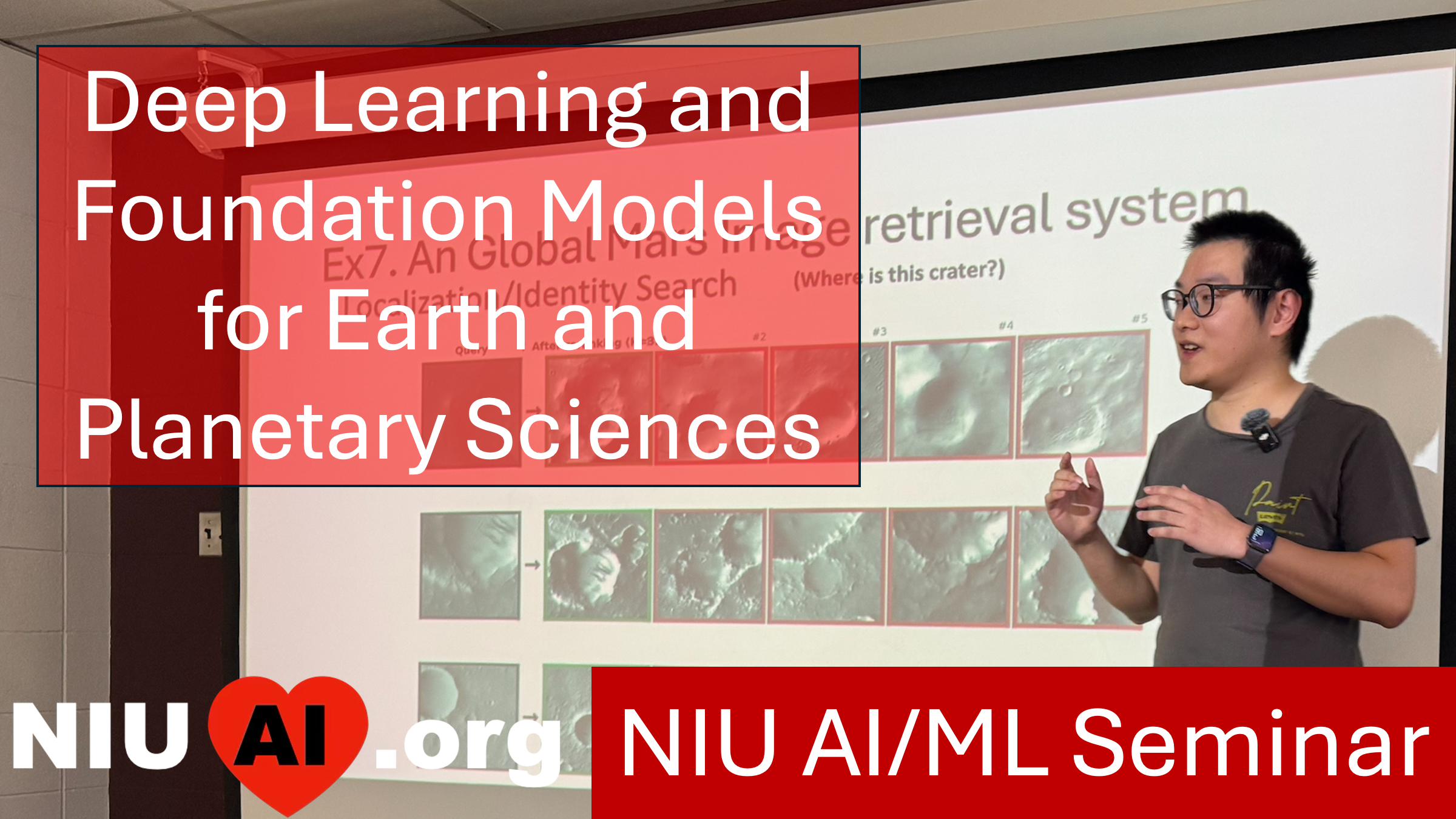
Download the presentation slides Overview On April 10, 2026, Jichao Fang, a Ph.D. candidate in the Department of Earth, Atmosphere and Environment at Northern Illinois University, presented his research on deep learning and foundation models for Earth and planetary sciences. Jichao is also a Master’s student in Computer Science and is expected to graduate this year. ...
Overview On March 27, 2025, Tanish Kumar, a PhD student in the Computer Science department at Northern Illinois University, delivered a presentation on Anatomy of an Autonomous AI Agent: From Frameworks to OS, a research area exploring the architectural transition from simple AI tools to integrated agent operating systems. As AI technology evolves, the industry faces a significant gap: while powerful frameworks exist, the challenge remains in how to effectively assemble and manage these components into a reliable system. In his talk, Kumar introduced OpenClaw, a local-first, open-source “Agent OS” designed to move beyond basic orchestration. He discussed the system’s core architecture, including its two-store memory model, lane-aware concurrency control, and the critical separation of the control plane and data plane to ensure security and reliability in production-grade AI agents.
Overview Download the presentation slides Today in our AI/ML seminar, we were pleased to have Maliha Zahan Chowdhury as the presenter. Maliha is a first-year PhD student in Dr. Zhishuai Guo’s research group. Her talk focused on Direct Preference Optimization (DPO), primarily based on the original 2023 DPO paper. Although the paper was published only three years ago, it has already been cited nearly 8,000 times, reflecting its significant impact on LLM alignment and optimization research. ...
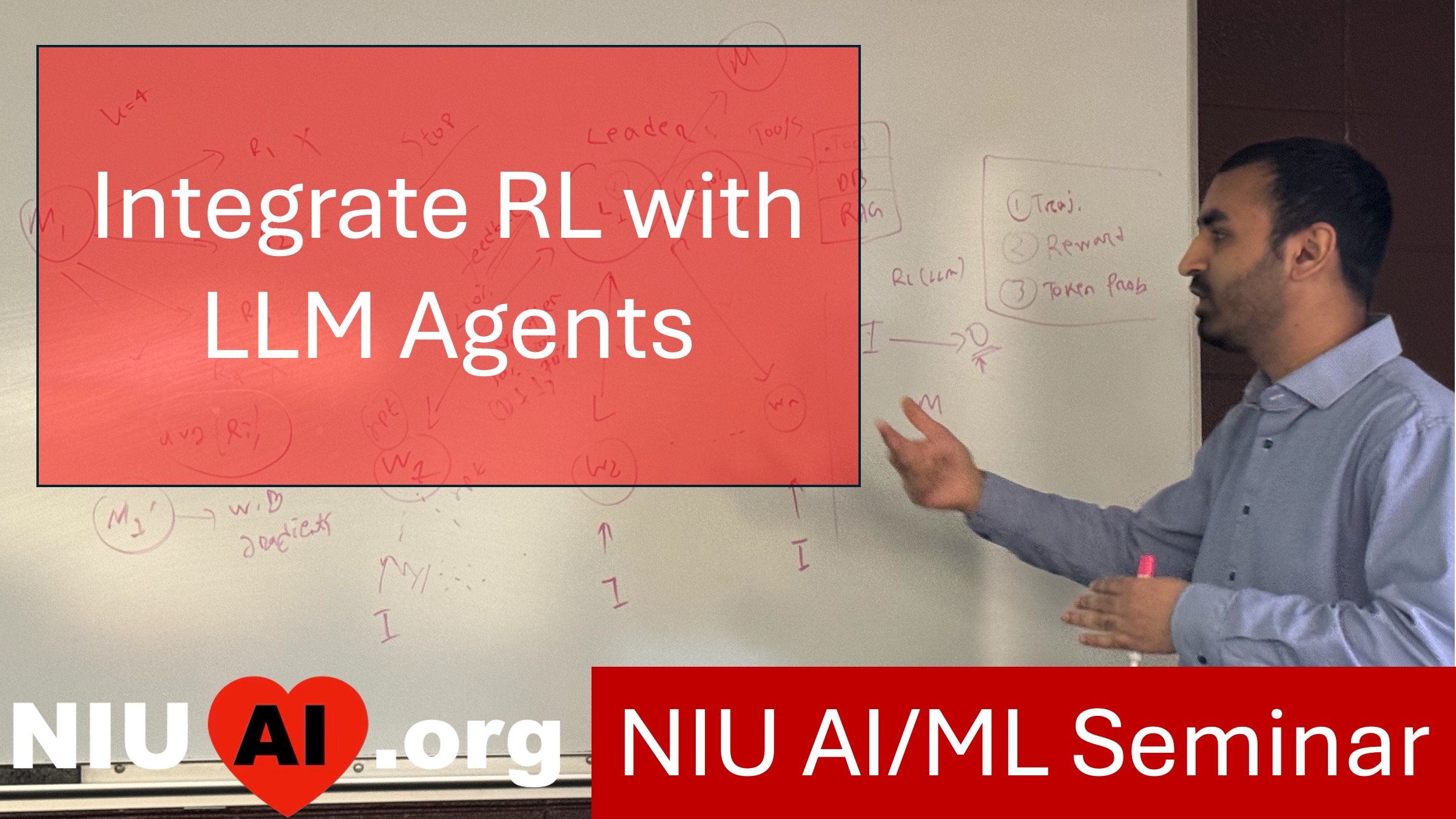
Download the presentation slides Overview and Motivation Presentation on integrating reinforcement learning concepts with LLM engines to improve performance Multiple approaches exist to enhance LLM performance: in-context learning, post-training (reinforcement learning), and fine-tuning Focus on efficiently integrating RL concepts with LLMs, particularly for multi-agent systems Covers differences between reinforcement learning on LLMs versus reinforcement learning on LLM agents Addresses RL implementation in HPC systems due to memory-intensive requirements Multi-Agent System Fundamentals Multi-agent systems consist of multiple LLMs, each with specific roles and functions State acts as history, compiling all previous agent turns, context, and evidence in multi-turn systems Communication Topologies ...
Overview On October 3, 2025, Md. Toyaha Rahman Ratul, a Ph.D. student at Northern Illinois University, presented a recent paper titled “On the Theoretical Limitations of Embedding-Based Retrieval,” authored by researchers from Google DeepMind and Johns Hopkins University. The paper formally examines and reveals the inherent limitations of single-embedding-based retrieval methods—approaches widely adopted in both industry and academia—thereby having a significant impact on the research community. ...
Overview On April 11, 2025, we were honored to host Dr. Imtiaz Karim, a Postdoctoral Researcher at Purdue University and incoming Assistant Professor at the University of Texas at Dallas, for a distinguished research talk titled “Systematic Security Analysis of Cellular Network Specifications and Implementations.” Dr. Karim presented a compelling overview of the security challenges in modern cellular networks, particularly 4G and 5G, and introduced CellularLint, a cutting-edge tool that uses large language models to identify inconsistencies in cellular specifications. He further discussed his methodologies for analyzing protocol implementations and revealed a range of vulnerabilities that have influenced updates to industry standards. The talk concluded with Dr. Karim’s vision for securing future wireless communication systems, including 6G. We sincerely thank Dr. Karim for sharing his impactful research and insights with our department.
Overview On March 28, 2025, Miftahul Jannat Mokarrama, a PhD student in the Computer Science department, presented a research topic on “LLMs as Judges,” a trending subject in the field of large language models. Her presentation provided a comprehensive survey covering functionality, methodology, applications, meta-evaluation, and limitations. Key conclusions included: LLMs as evaluators are versatile, evaluation is context-specific, challenges persist, human-AI collaboration is essential, and evaluation should extend beyond traditional research papers.